What Is the Hypergeometric Distribution?
The hypergeometric distribution is a discrete probability distribution that describes the likelihood of drawing a specific number of "successes" from a finite population, without replacement. In formal terms, it models the number of successes in a sequence of draws from a population of known size, where each draw either succeeds or fails and where each draw changes the composition of the remaining population.
This distribution is the mathematically correct model for card games such as Magic: The Gathering. When a player draws a card from a library, that card is removed from the pool of available cards. The probability of the next draw depends on what was drawn before it. This is fundamentally different from models like the binomial distribution, which assumes each trial is independent with a fixed success probability — as in coin flips or dice rolls, where previous outcomes do not alter future odds.
Consider a concrete example: a 60-card deck contains 24 lands. The probability that the first card drawn is a land is 24/60 = 40.0%. If that first card is indeed a land, only 23 lands remain among 59 cards, and the probability of the second card being a land drops to 23/59 = 39.0%. If the first card was not a land, the probability rises to 24/59 = 40.7%. The hypergeometric distribution accounts for this shifting composition across all draws simultaneously, producing an exact probability for any specified outcome.
Deck builders and competitive players rely on hypergeometric calculations to make informed construction decisions. Questions such as "How many removal spells are needed to reliably draw one by turn 4?" or "What land count produces a consistent mana base?" are answered precisely by this distribution. The work of noted MTG mathematician Frank Karsten on mana base requirements, widely referenced in the competitive community, is grounded in hypergeometric probability.
The Hypergeometric Formula
The probability of drawing exactly k successes in n draws from a population of N items containing K successes is given by:
Each component of this formula has a specific meaning:
- N — the total population size (total cards in the deck).
- K — the number of success states in the population (copies of the desired card or effect in the deck).
- n — the number of draws (the sample size — for example, a 7-card opening hand).
- k — the number of observed successes (how many copies of the desired card appear in the sample).
- C(a, b) — the binomial coefficient, read "a choose b," representing the number of ways to select b items from a set of a items. It is calculated as C(a, b) = a! / (b! × (a − b)!), where "!" denotes the factorial function.
The formula works by counting favorable outcomes and dividing by total possible outcomes. C(K, k) counts the number of ways to choose k successes from the K available successes. C(N − K, n − k) counts the number of ways to fill the remaining n − k slots in the sample with non-successes. C(N, n) counts the total number of possible n-card hands from the full deck. The ratio of favorable to total outcomes yields the exact probability.
To find the probability of drawing at least a certain number of successes — the most common question in deck building — one sums the probabilities for all values of k from the desired minimum up to the maximum possible. Alternatively, for "at least 1," the complement method is often simpler: P(X ≥ 1) = 1 − P(X = 0).
Practical Examples
Opening Hand: Drawing a Boardwipe

A Commander deck contains 99 cards in the library (the commander occupies the command zone and is not part of the draw pool). Suppose the deck includes 4 board-clearing effects such as Wrath of God. The question: what is the probability of having at least one boardwipe in an opening hand of 7 cards?
Parameters: N = 99, K = 4, n = 7, desired: k ≥ 1.
Using the complement method: P(X ≥ 1) = 1 − P(X = 0). The result is 25.8% — roughly one game in four, the player will have access to a boardwipe from the opening hand. This number underscores why Commander deck builders often include 5 or more board sweepers if that effect is considered essential to the game plan.
Creature Density
Aggressive strategies in 60-card formats depend on deploying multiple creatures in the early turns. With 12 creatures in a 60-card deck, what is the probability of drawing 2 or more in an opening hand of 7?
Parameters: N = 60, K = 12, n = 7, desired: k ≥ 2.
The probability is 42.8%. This means that fewer than half of opening hands will contain the two-creature start an aggro deck typically requires. Deck builders addressing this problem have two main options: increase the creature count (16 creatures raises the two-or-more probability significantly) or include cantrips and card selection to improve effective density without adding more creature slots.
Finding a Combo Piece
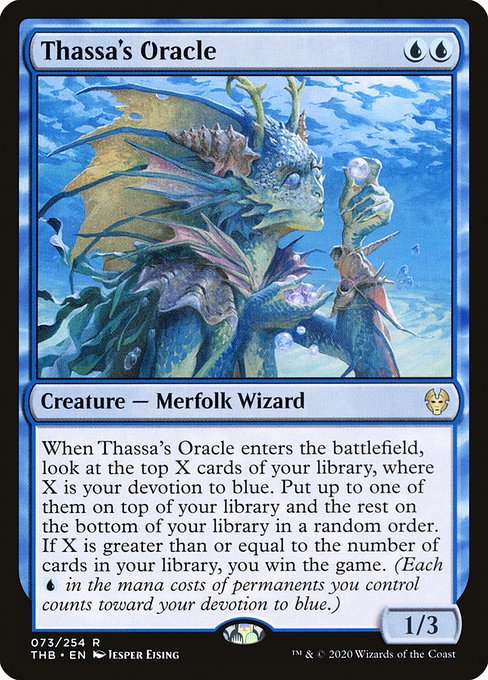
Consider a 60-card deck running a single copy of a critical combo piece such as Thassa's Oracle. By turn 5 on the play, the player has seen 12 cards total (7 in the opening hand plus 4 draw steps, assuming no mulligans and no additional card draw). What is the probability of having drawn that one copy?
Parameters: N = 60, K = 1, n = 12, desired: k ≥ 1.
The probability is 20.0% — only one game in five. This result explains why competitive combo decks invest heavily in card selection (Brainstorm, Ponder, tutors) or run redundant combo pieces. Relying on natural draws alone to find a single copy is statistically unreliable. For reference, a single copy in the same 60-card deck has only an 11.7% chance of appearing in the opening 7 cards.
Land Consistency
Consistent mana development is the foundation of competitive Magic. The standard question: with 24 lands in a 60-card deck, what is the probability of drawing between 2 and 4 lands in an opening hand of 7?
Parameters: N = 60, K = 24, n = 7, desired: 2 ≤ k ≤ 4.
The probability of this "playable" land range is 77.5%. Separately, the probability of drawing at least 2 lands — the minimum most decks need to function — is 85.7%. These numbers are a primary reason why 24 lands has been the default starting point for 60-card deck construction across decades of competitive play. The roughly 14% chance of drawing 0 or 1 land represents the "non-game" rate that mulligans are designed to mitigate.
Consistency of 4-Ofs
In Standard, Modern, and Pioneer, the maximum number of copies of any non-basic card is 4. Running the full playset maximizes the probability of drawing at least one copy. In a 60-card deck with 4 copies, drawing a 7-card opening hand:
Parameters: N = 60, K = 4, n = 7, desired: k ≥ 1.
The probability is 39.9% — fewer than two games in five will produce a copy in the opener. This is a critical number for deck construction: even at the maximum legal copy count, there is a 60.1% chance of not seeing a specific 4-of in the opening hand. This is why top-performing decks often run 8 or more cards that serve the same strategic role (for example, 8 one-mana removal spells rather than just 4 copies of a single card). Redundancy across functional equivalents is one of the most effective tools for increasing consistency.
Mana Color Consistency
Multi-color decks face the additional challenge of drawing the correct colors of mana. Frank Karsten's widely cited research applies hypergeometric probability to this problem. For a card with a single colored mana pip, running 14 sources of that color in a 60-card deck gives an 86.1% probability of drawing at least one source in the opening 7 cards. For cards requiring two pips of the same color, 18 sources produce a 68.6% chance of drawing 2 or more sources in 7 cards. These benchmarks form the basis of modern mana base construction in competitive formats.
Niv-Mizzet Reborn & Multi-Category Draws
The calculator above tracks a single category of card. Some questions, though, involve several categories at once. The two extra modes on this page — Niv-Mizzet and Combo draw — answer those using the multivariate hypergeometric distribution, computed exactly with no Monte Carlo simulation.
How many cards does Niv-Mizzet Reborn draw?
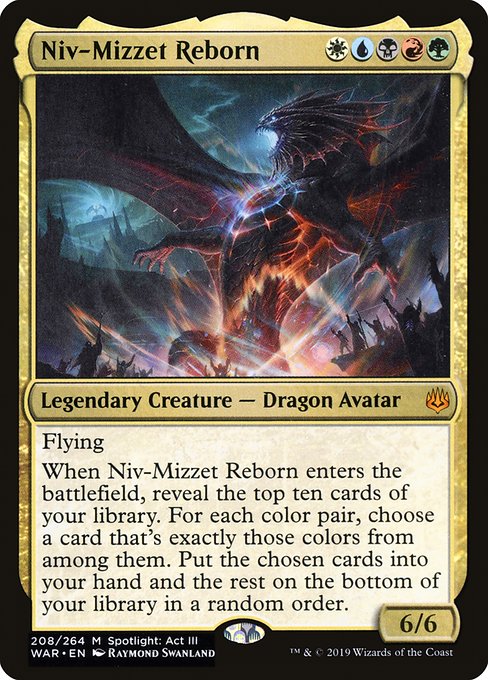
Niv-Mizzet Reborn reveals the top ten cards of your library and puts one card of each color pair (a card that is exactly those two colors) into your hand. The number of cards it draws therefore equals the number of distinct two-color guilds present in the reveal — not a simple "X copies in Y cards" question, which is why a standard calculator cannot answer it.
The Niv-Mizzet mode handles it directly. Enter how many exactly-two-color cards you run of each of the ten guilds (W/U, W/B, … R/G). For a typical low-power build with 6 cards in each pair (60 two-color cards in a 99-card deck), Niv-Mizzet draws 4.81 cards on average — most often 5, with a 60.7% chance of 5 or more.
The result is exact. By linearity of expectation, the average equals the sum of each guild's chance of appearing at least once among the ten revealed cards: with 6 cards a guild has a 48.1% chance to show up, and 10 × 48.1% = 4.81. The mode also returns the full distribution — your odds of drawing exactly 3, 4, 5, … cards — and a built-in check that all probabilities sum to 100%.
Drawing Several Things at Once (Combo Draws)
"What are the odds my opening hand has at least 2 lands and at least 1 removal spell?" is a multi-category question. Because a card drawn toward one requirement uses up a slot that can't also fill the other, the true answer is lower than multiplying the two individual chances together. The Combo draw mode computes this exact joint probability. For a 60-card deck with 24 lands and 8 removal spells, the chance that an opening 7 satisfies both is 53.7% — compared with 85.7% for the lands alone and 65.4% for the removal alone. You can add as many requirements as you like, and the calculator accounts for the full multivariate interaction between them. Set your sample directly as a card count, or specify it by turn with a play/draw toggle — the starting player skips their first-turn draw (rule 103.8a), so you have seen one fewer card on the play than on the draw.
How to Use This Calculator
This calculator accepts four parameters that map directly to the variables in the hypergeometric formula. Setting them correctly ensures accurate results.
- Deck Size (N — Population Size): The total number of cards in the library at the time of drawing. Standard, Modern, and Pioneer decks use a 60-card minimum. Limited decks (draft and sealed) use 40 cards. Commander decks contain 99 cards in the library — the commander itself occupies the command zone and is not part of the drawable population.
- Copies in Deck (K — Successes in Population): The number of cards in the deck that count as a "success" for the question being asked. This can be copies of a specific card (e.g., 4 copies of Lightning Bolt) or the total count of cards serving a particular role (e.g., 10 removal spells, 24 lands, 14 blue sources). Grouping functional duplicates is a powerful technique for evaluating role-based consistency.
- Cards Drawn (n — Sample Size): The number of cards that will have been seen. An opening hand is 7 cards. On the play, the player does not draw on turn 1, so turn 2 represents 8 cards seen, turn 3 is 9, and so on. On the draw, add one additional card (turn 1 on the draw is 8 cards seen). The calculator also generates a turn-by-turn probability table automatically.
- Successes Desired (Minimum k): The minimum number of target cards needed. Set to 1 for "at least one copy." Set to 2 for scenarios like "draw at least 2 lands" or "find both combo pieces." The results panel displays exact probabilities for every possible value of k, as well as cumulative probabilities.
After entering parameters, click Calculate or simply modify any input — results update in real time. The output includes exact probabilities for each possible outcome (P(X = 0), P(X = 1), etc.), cumulative probabilities (P(X ≥ 1), P(X ≥ 2), etc.), and a turn-by-turn progression table that shows how probabilities evolve with each additional draw step.
Common Mistakes
Several errors frequently arise when applying probability to deck building. Understanding these pitfalls helps avoid flawed conclusions.
Using Binomial Instead of Hypergeometric
The binomial distribution assumes independent trials with a fixed probability — equivalent to drawing a card, recording the result, then replacing it before the next draw. In MTG, cards are drawn without replacement, so the binomial model is incorrect. The error is small when the deck is very large relative to the number of draws, but for typical MTG parameters (60-card deck, 7-card hand), the difference between binomial and hypergeometric results is measurable and can lead to incorrect deck construction decisions. Always use the hypergeometric distribution for MTG probability.
Forgetting Deck Size Changes After Mulligans
Under the London mulligan rule, each mulligan draws a fresh hand of 7 cards from the full, unmodified deck. The player then puts a number of cards from that hand on the bottom of the library equal to the number of mulligans taken. A critical nuance: the initial draw of 7 always comes from the complete deck, so each mulligan attempt is an independent sample. However, the final hand size is reduced (6 cards after one mulligan, 5 after two), which affects the probability of having the desired card in the hand actually kept. The calculator models the initial 7-card draw; adjustments for cards put back require additional analysis.
Not Accounting for Cards Seen After Draws
A common mistake is evaluating only the opening hand without considering the additional cards seen through regular draw steps, cantrips, and card selection spells. The probability of finding at least one copy of a card increases meaningfully with each additional card seen. When evaluating whether a deck has "enough" of a particular effect, the relevant question is often not "What are the odds in the opener?" but "What are the odds by the turn I need it?" Using the calculator's turn-by-turn table or adjusting the sample size parameter provides a more complete picture.
Conflating "At Least" with "Exactly"
P(X = 1) and P(X ≥ 1) are different quantities. The probability of drawing exactly 1 copy is not the same as drawing at least 1 copy, because the latter includes the cases of drawing 2, 3, or more. Deck building questions almost always concern cumulative probabilities ("at least 1 land," "at least 2 creatures"), not exact counts. The calculator displays both, so be sure to read the correct row.
Frequently Asked Questions
What are the odds of drawing a specific card in my opening hand?
In a 60-card deck with 4 copies, you have a 39.9% chance of drawing at least one copy in your opening 7 cards. In a 99-card Commander deck with a single copy, the probability drops to just 7.1%. The hypergeometric distribution calculates this exactly by accounting for the shrinking deck as each card is drawn.
How do I calculate draw probability for Commander/EDH?
Set the deck size to 99 (your commander is in the command zone, not the deck). Enter how many copies of the desired effect you run — since Commander is singleton, this is usually 1 for a specific card, but you can group functional duplicates together. For example, if you run 10 ramp spells, set copies to 10 to find the odds of drawing at least one.
What is the difference between hypergeometric and binomial distribution?
The hypergeometric distribution models drawing without replacement from a finite population, which is exactly how MTG works — once you draw a card, it leaves your library. The binomial distribution assumes each draw is independent with a fixed probability (drawing with replacement). For MTG, hypergeometric is the correct model because the composition of your deck changes with every card drawn.
How many copies of a card should I run for consistency?
In a 60-card deck drawing 7: with 4 copies you have a 39.9% chance of seeing one in your opener; with 8 copies (or functional equivalents) it jumps to 65.4%; with 12 copies it reaches 80.9%. For effects you need every game, aim for 8-12 slots. For situational cards, 2-4 copies is typical. Use the calculator with different copy counts to find the right number for your desired consistency.
How many cards does Niv-Mizzet Reborn draw?
Niv-Mizzet Reborn reveals the top ten cards and puts one card of each color pair (exactly two colors) into your hand, so it draws as many cards as there are distinct guilds in the reveal. Use the calculator's Niv-Mizzet mode and enter how many two-color cards you run of each pair. For a low-power build with 6 cards in each of the ten pairs (60 cards in a 99-card deck), it draws 4.81 cards on average — most often 5, with about a 60.7% chance of 5 or more. The mode shows the full distribution and the chance each individual pair appears.
Can I calculate the odds of drawing two different things at once?
Yes — use the Combo draw mode. It computes the exact joint probability that a single draw meets several requirements at the same time, such as "at least 2 lands and at least 1 removal spell" in your opening 7. For a 60-card deck with 24 lands and 8 removal spells that is 53.7%. This joint chance is lower than multiplying the individual odds (85.7% × 65.4%), because a card drawn toward one requirement can't also satisfy another — the multivariate hypergeometric distribution accounts for this exactly.
Should I calculate on the play or on the draw?
Use the play/draw toggle on the turn-by-turn table. The starting player skips their first-turn draw (Comprehensive Rule 103.8a), so on the play you have seen 7 + (turn − 1) cards by a given turn, while on the draw you have seen 7 + turn — one more, because you draw every turn. That single extra card slightly raises your odds of having found a given card by any point, which partly compensates the player going second. Your opening hand is 7 cards either way.
What are the odds of drawing 2 or more lands in my opening 7?
With 24 lands in a 60-card deck, the probability of drawing at least 2 lands in the opening 7 is 85.7%. These numbers help explain why land counts in competitive decks cluster around 24-26 for 60-card formats.
How does the London mulligan affect these probabilities?
The London mulligan lets you draw a fresh 7 cards each time, then put cards back equal to the number of mulligans taken. Each mulligan is an independent 7-card sample from the full deck, so you can calculate the probability of NOT finding your card in one hand, then raise that to the power of the number of hands seen. For example, if the chance of missing a 4-of in 7 cards is 60.1%, after one mulligan the chance of missing in both hands is 0.601 x 0.601 = 36.1%.
What sample size should I use for the calculator?
Use 7 for your opening hand. For turn-by-turn odds on the play, add turns minus one: turn 1 is still 7 (no draw), turn 2 is 8, turn 3 is 9, and so on. On the draw, add one more card. The calculator's built-in turn-by-turn table shows this automatically. For Limited (draft or sealed), use 40 as the deck size.
How does deck size affect draw probability?
Smaller decks give higher consistency. Four copies in 40 cards gives a 55.2% chance of seeing one in 7, versus 39.9% in 60 cards and 25.8% in 99 cards. This is why Limited (40-card) decks feel more consistent than Constructed, and Commander has more variance. It also explains why some competitive Commander lists run as many functional duplicates as possible for key effects.
Related Guides & Tools